Updated October 2026 · By Bencke’s Tile
What counts as large format?
The Tile Council of North America (TCNA) treats a tile as large format when one edge is longer than 15 inches. Common sizes are 12 x 24, 24 x 24, 24 x 48 and bigger. Thin porcelain panels can be even larger.
People choose large tile for the look. With fewer joints, a floor or wall reads as one calm surface, and there is less grout to clean.
Small tile vs large tile
Big tile is not simply small tile made bigger. It changes how the job is built.
| Small tile | Large format tile | |
|---|---|---|
| Grout lines | Many | Fewer |
| Surface flatness | Forgiving | Must be much flatter |
| Mortar | Standard thinset often works | A mortar made for large and heavy tile, with back-buttering |
| Shower floor | Follows the slope easily | Hard to fit to the slope of a center drain |
| Handling | Easy for one person | Heavy and fragile; often two people and special tools |
| Waste | Lower | Higher, since each cut piece wastes more |
The surface must be flat
This is the number one rule. Under small tile, a floor can wander by about a quarter inch over 10 feet and nobody notices. For large format tile, the installation standard (ANSI A108.02) asks for no more than 1/8 inch of variation over 10 feet, and no more than 1/16 inch over 24 inches.
If the floor or wall is not that flat, the fix happens first. That can mean grinding high spots, patching, or pouring a self-leveling underlayment. A lazy shortcut here shows up later as tile edges that stick up, called lippage.
Mortar coverage: no hollow spots
Under every tile, the thinset must make contact over most of the back. The standard (ANSI A108.5) asks for at least 80 percent contact in dry areas and at least 95 percent in wet areas such as showers, and the coverage must reach the corners and edges.
To get there, installers use a bigger trowel, comb the thinset in one direction, and spread a thin coat on the back of the tile too, called back-buttering. Many large tiles need a mortar made for large and heavy tile. A careful setter lifts a tile now and then to check the back. A tile with hollow spots under it can crack when something heavy lands on it.
Lippage: the uneven edge problem
Lippage is when one tile edge sits higher than its neighbor. Large tiles make it easier to see. Common causes are an uneven surface, tile that is slightly bowed at the edges, and the wrong pattern.
The fixes work together. Start with a flat surface. Use a leveling clip system to hold neighbors at the same height while the thinset cures. Choose a joint width your installer is comfortable with, because wider joints are more forgiving. And choose the right pattern.
The pattern matters: 1/3 offset, not 50 percent
If you like a brick look, large rectangular tile can be set in an offset pattern. But the edges of many big tiles bow slightly in the middle or at the ends. Offset the tiles by half and those high and low points can land next to each other. The installation standard says to keep the offset to 33 percent for tile with a side longer than 15 inches, unless the tile maker says otherwise. A one-third offset looks good and hides edge bow.
Floors need a stiff base
Large tile does not bend. If the floor under it flexes, tile and grout crack. The common guideline is that a tile floor should not deflect more than L/360 under load, which means the span divided by 360. In an older home with a bouncy floor, a good installer may suggest stiffening it first. This is a conversation to have before you buy the tile.
Showers and walls
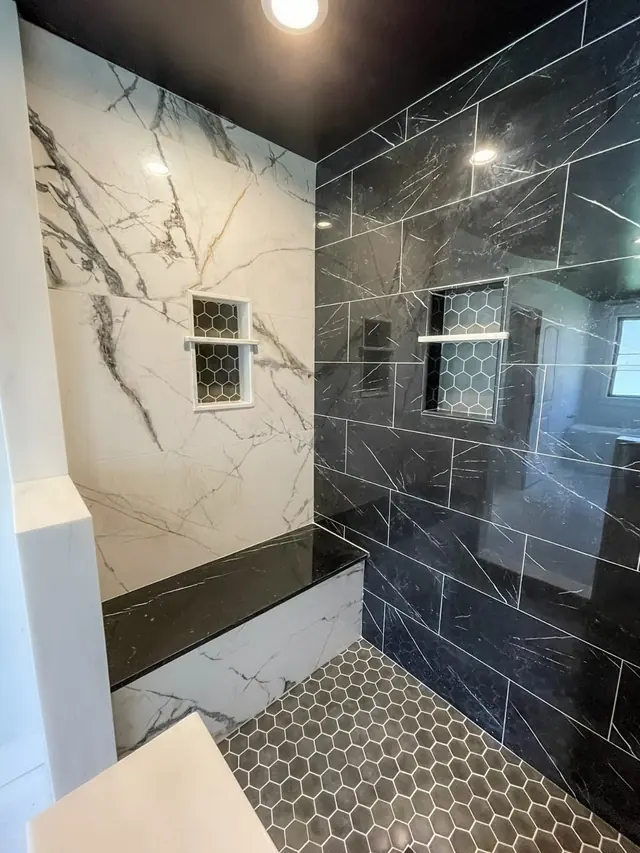
Big tile on a shower wall can look wonderful, and the fewer joints are easier to keep clean. It needs a flat wall, a mortar that does not sag, and a membrane behind it that is done right. The tile itself is not the waterproofing, and that matters more with fewer joints, not less. See our shower waterproofing guide.
On the shower floor, big tile is a poor fit when the floor slopes to a drain in the center. Small tile or a mosaic follows that slope. A linear drain, which lets the whole floor slope one way, can work with larger tile.
Rectified tile and joint width
Rectified tile has edges cut to a precise size after firing, so the pieces are very uniform and joints can be thinner. Tile makers set a minimum joint, and the installation standard sets minimums for big tile too. Do not push your installer to go under the maker’s number. A slightly wider joint is easier to set and hides small size differences.
Buying and handling
Order extra, because large tile wastes more at the edges. Buy all the tile from the same production lot. Have it delivered early and check each box for chips. Large tile is heavy, so the day of the job needs two people and, for the biggest sizes, special lifting tools.